

Values
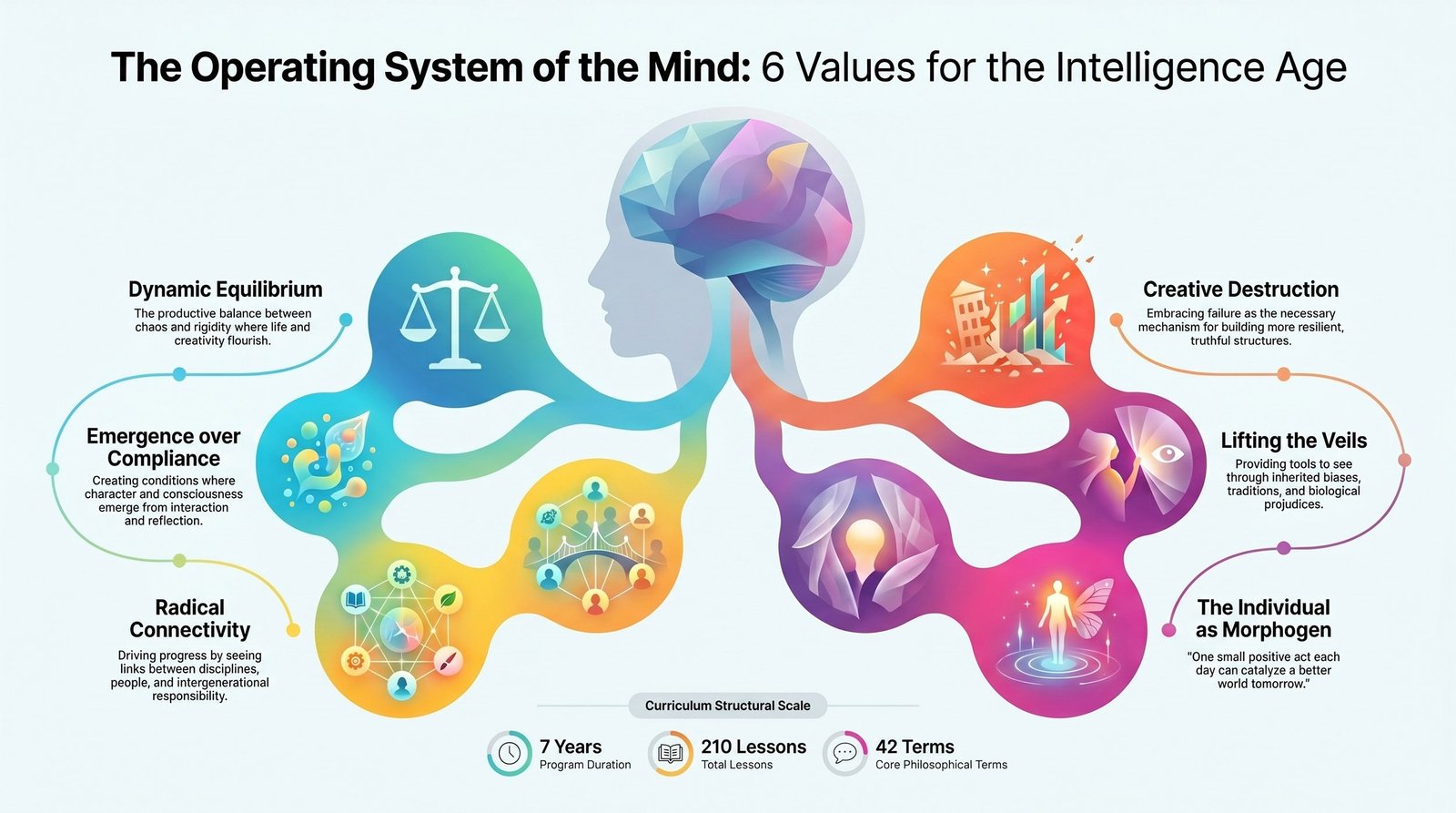
Our values are drawn from the universal principles explored in The Emergence of Awe book. They are not slogans. They are the operating system of the curriculum.
Equilibrium
The most beautiful and productive outcomes — in nature, in thought, in human society — emerge from states of balance. Not stasis, but dynamic equilibrium: the Goldilocks zone between too much chaos and too much rigidity, where life, creativity, and justice can flourish. The same principle that positions Earth at precisely the right distance from the Sun governs the brain’s neuron balance, the health of democracies, and the courage to hold two competing ideas simultaneously. Equilibrium is our North Star.
Emergence
The whole is greater than the sum of its parts. Consciousness emerges from interaction. Wetness emerges from water molecules. A student’s character emerges from seven years of thinking, questioning, failing, and reflecting. One does not prescribe outcomes; one creates the conditions from which they emerge. Assessment measures growth, not compliance.
Connectivity
All progress — from the Big Bang to the smartphone — is driven by interaction and connection. The more connected we are, the faster progress occurs, but also the greater the responsibility. Students are taught to see the connections between disciplines (science, philosophy, history, ethics), between people (empathy, dialogue, collaboration), and between past and future (legacy, systems thinking, intergenerational responsibility).
Creative Destruction
Growth requires letting go. Stars must die for elements to form. Cells must destroy themselves to regenerate. Identities must be dismantled for deeper ones to emerge. Students are taught that failure is not the opposite of success but the mechanism of it — that within every breakdown lie the seeds of a more resilient and truthful structure.
Lifting the Veils
Much of what we take for granted — our beliefs, assumptions, biases, even our experience of time — is shaped by forces we did not choose: the biology of our senses, the traditions we inherited, the structures of the societies we were born into. These are the veils of prejudice. Education should not add more veils; it should give students the tools to see through them, and the courage to act responsibly.
Awe
Awe is not a luxury but a cognitive and moral resource. It connects us to something larger than ourselves, interrupts the autopilot of habit, and reminds us that the world is deeper, stranger, and more beautiful than we usually allow ourselves to notice. Awe is the starting point of philosophy, science, and ethical imagination. It is the fuel that sustains a lifetime of inquiry.